

Guide
Free backtesting software for forex: what makes a backtest trustworthy, and what free actually gets you
 Tommy J.Founder, RoboticEA
Free backtesting software is easy to find. A free backtest you can believe is harder, because the things that decide whether a result is real — the price data, the spread, commission and swap, how many years it covers, and whether those years were used to pick the strategy — are exactly the settings a results screen hides. This guide covers what to check in any forex backtesting tool, using numbers from our own studies, and then lists what RoboticEA’s free tier does and does not include: a one-time 250 tokens, no card.
The short answer
Method
What makes a forex backtest worth trusting
A backtest is a simulation, and a simulation only knows what you give it. Five inputs decide almost all of the difference between a backtest that predicts something and one that only flatters. We have measured four of them directly, so here are the measurements rather than general advice.
1. The price path: real data, and how finely it is replayed
Inside every bar, price takes a path, and that path decides whether your stop or your target was hit first. A backtest that knows only the open, high, low and close has to guess. We tested how much that matters by running 100 strategies through both our engine and MetaTrader 5’s tester on EURUSD, first on a stream our own importer had built from bars (four points per five-minute bar, 273,200 ticks for the window), then on 24,596,614 real recorded ticks, about 90 times as many.
3,461
median real ticks in one H1 bar
48
points per H1 bar, bar-built stream
8.97 pp
median engine-vs-MT5 gap, bar-built
6.07 pp
median gap, real ticks
Feeding both simulators the same real ticks cut the median disagreement in total return from 8.97 pp to 6.07 pp, and 90 of the 98 scored strategies landed within 10% of each other on trade count. Two independent engines got close once they replayed the same prices. The full write-up, including where they still disagree, is in our MT5 Strategy Tester accuracy study. What it means for choosing software: ask what the price data is, where it came from, and how finely the tool replays it inside a bar.
One related trap is worth knowing about. Some engines quietly fall back to generated prices when real data is missing, and a generated-price backtest looks exactly like a real one. Ours refuses to record a result built on synthetic data. The run fails instead.
2. The spread: recorded, not assumed
This is the biggest single lever we have found. We generated 4,961 strategies, ran the 4,129 on intraday timeframes (M5 to H4) on gold in each of the 8 full years from 2018 to 2025, and then repeated the identical 33,032 yearly backtests three times with different costs. The first run charged gold’s real recorded per-bar spread, the second a flat one-pip spread, the third nothing at all. The strategies never changed.
Charging a flat pip instead of the recorded spread turned 2,784 of those yearly backtests (8.4%) from a loss into a profit. Removing costs entirely flipped 7,920 (24.0%). Nobody had to fudge anything to get those results. One default setting did it. Spread matters most on gold, indices and short timeframes, which is why timeframe and instrument choice move results as much as they do.
3. Commission and swap, charged and shown
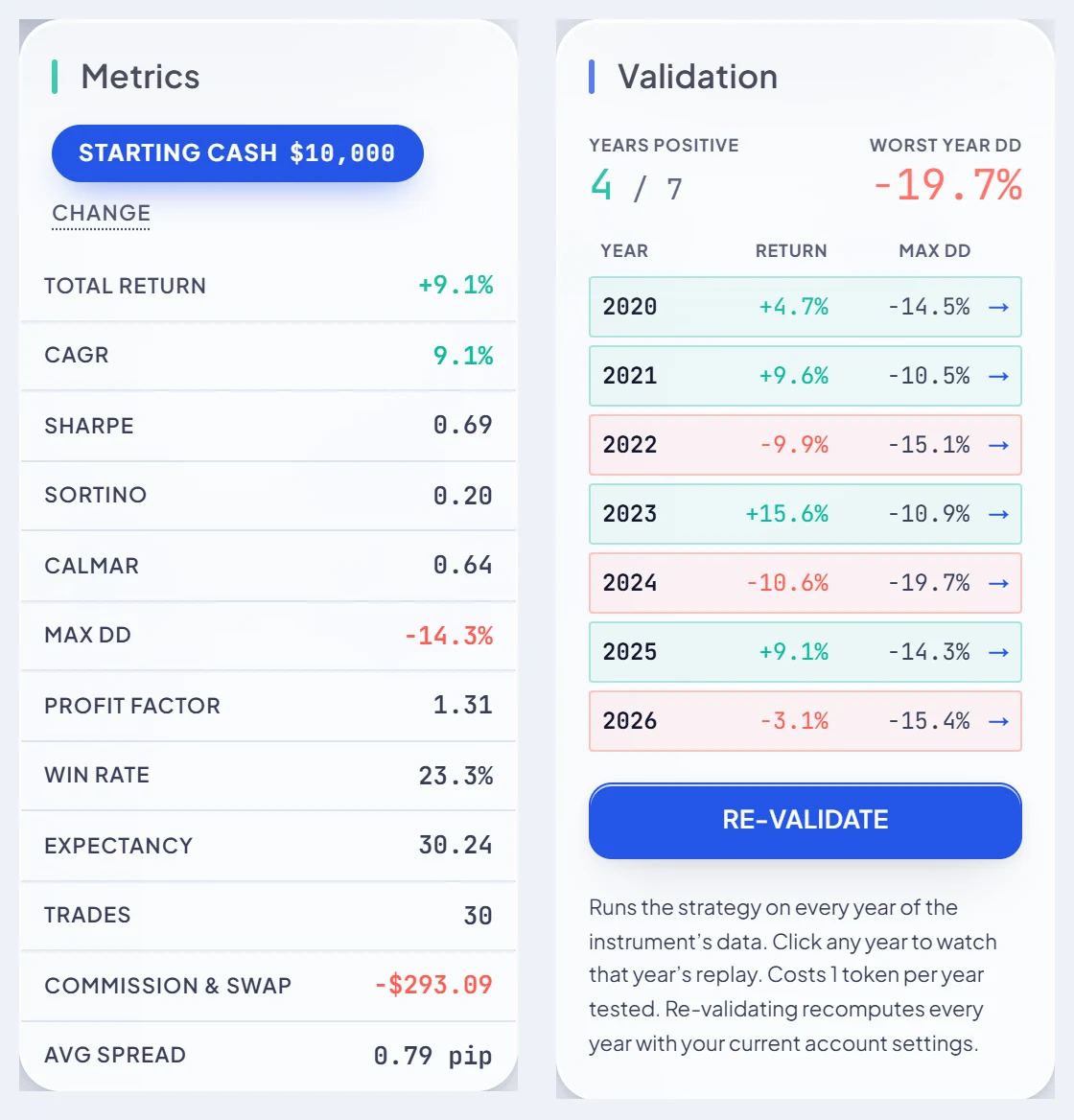
A tool can charge commission and overnight swap and still not tell you what they cost. You want them charged inside the run, as each trade opens, holds overnight and closes, and then reported next to the return with the average spread actually paid, so you can see what the strategy earned and what the friction took.
4. Enough years, each one shown separately
A single year tells you about that year. On the same gold population, only 6.5% of strategies made money in 2018, against 30.6% in 2025. That is the same strategies on the same engine, with nothing changed except the calendar. Whoever picks the window can make a strategy look like almost anything. So look for software that can show you one row per year, with the losing years left in, rather than a single compounded curve.
5. Years you did not use to choose the strategy
The fifth input catches out careful people. If you pick the best of many backtests, part of what you picked is luck, and the luck does not repeat. In our GBPUSD study we ranked strategies on 2018-2023 only, then scored them on 2024-2025, which they had not been chosen on.
+333% → −51%
the top 100 by 2018-2023 return, then on 2024-2025
The 100 best GBPUSD strategies on the selection years compounded a median +333% there, then a median −50.9% over the next two years, worse than the −11.3% median of every eligible strategy. In-sample rank was not a forecast.
Software cannot fix that for you, but it can make it easy to keep years aside: run each year as its own backtest, choose on some years, and judge on the rest. The GBPUSD study has the full holdout.
Checklist
What to look for in any backtesting software
The best backtesting software for you depends on whether you write code and what you trade, so instead of a ranking, here is a checklist that works for any backtesting platform, free or paid. A free tool that passes it is a better choice than a paid one that does not.
| Check | Why it matters | Ask |
|---|---|---|
| Real price data | Generated or patched prices produce results that look real. | Where does the data come from, and what happens when it is missing? |
| Intrabar detail | Stop-versus-target order is decided inside the bar. | Ticks, one-minute bars, or OHLC only? |
| Recorded spread | A flat pip flipped 8.4% of our gold years to profit. | Is the spread recorded per bar, or one number for everything? |
| Commission and swap | Holding costs add up on slower strategies. | Are they charged inside the run and shown next to the return? |
| Every year separately | One window can be cherry-picked. | Can I see a per-year table with the losers in it? |
| Out-of-sample years | The best in-sample pick is partly luck. | Can I keep years aside and test on them? |
| Drawdown beside return | A return without its worst loss is half a result. | Max drawdown, and can I watch it happen? |
| A path to live trading | A backtest you cannot deploy is a report, not a tool. | Does it run in, or export to, the platform I trade on? |
Free option one
The free backtesting software you may already have: MetaTrader 5
If you trade through a MetaTrader 5 broker, you already have a capable backtester. The Strategy Tester comes with the terminal. According to MetaQuotes’ own documentation (checked November 2026), its “Every tick based on real ticks” mode tests on “real ticks of financial instruments, accumulated by brokers” with “no simulation”. It also has a visual mode for watching an expert advisor trade on history, multi-currency testing, and parameter optimisation. It passes most of the checklist above, and it is the tool our own exported strategies are checked against.
What it asks of you is an expert advisor to test. That means writing MQL5, hiring someone, or downloading one you cannot fully inspect. It also leaves per-year and holdout testing to you, run by run. That is the gap RoboticEA fills. It is a place to find and stress-test a strategy before it goes into MetaTrader 5, and it does not replace MT5. Every strategy you keep can be exported as a readable .mq5 and run in the Strategy Tester on your own broker’s data. We recommend doing that before trading it.
Free option two
What RoboticEA’s free backtesting includes
RoboticEA meters work in tokens, one per new backtest. A new account gets 250 once, with no card and no trial clock, and every figure below comes from the same pricing module the server charges with.
| What you do | Tokens | What 250 covers |
|---|---|---|
| One new backtest one strategy, one window | 1 | 250 backtests |
| A batch of 50 generated strategies each one backtested as it lands | 50 | 5 batches |
| Per-year validation, 9 years 2018 to the current partial year, each its own run | 9 | 27 validations |
| Trade replay any run you already have | 0 | always free |
| MetaTrader 5 export readable .mq5 source | 0 | always free |
The backtest itself
- Real market data. Five-minute bars are the finest we store, and every coarser timeframe is built from them. The data covers 2018 to the present, and a run that would have needed generated prices is refused.
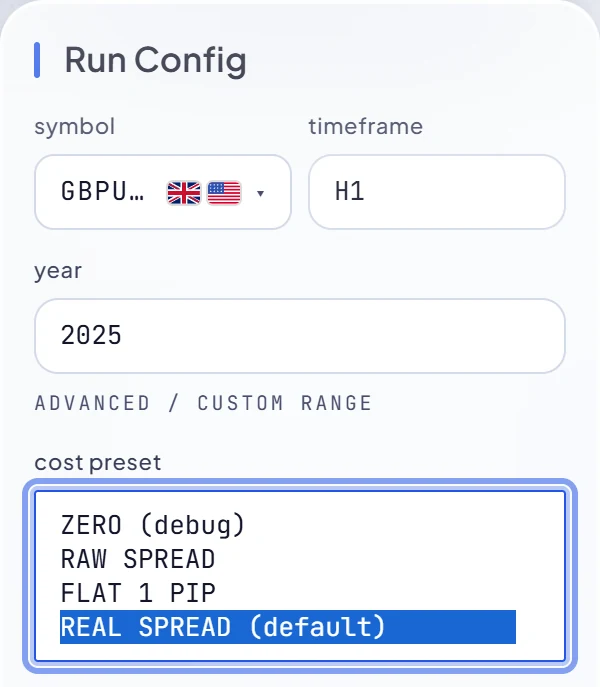
- Real recorded spread by default. Every run charges the spread recorded on each bar, plus commission and overnight swap, inside the simulation. On the free tier that cost model is fixed, so you cannot accidentally test without costs.
- The full metric set. Return, CAGR, Sharpe, Sortino, Calmar, max drawdown, profit factor, win rate, expectancy and trade count, plus what commission and swap cost and the average spread paid, each on its own line.
- No code. Strategies come from Compose: pick a direction, an instrument and timeframes, set a few ranges, and it generates and backtests a batch. On free, the directions are Trend, Momentum, Trend Confirmation and Mean Reversion.
Watching it trade
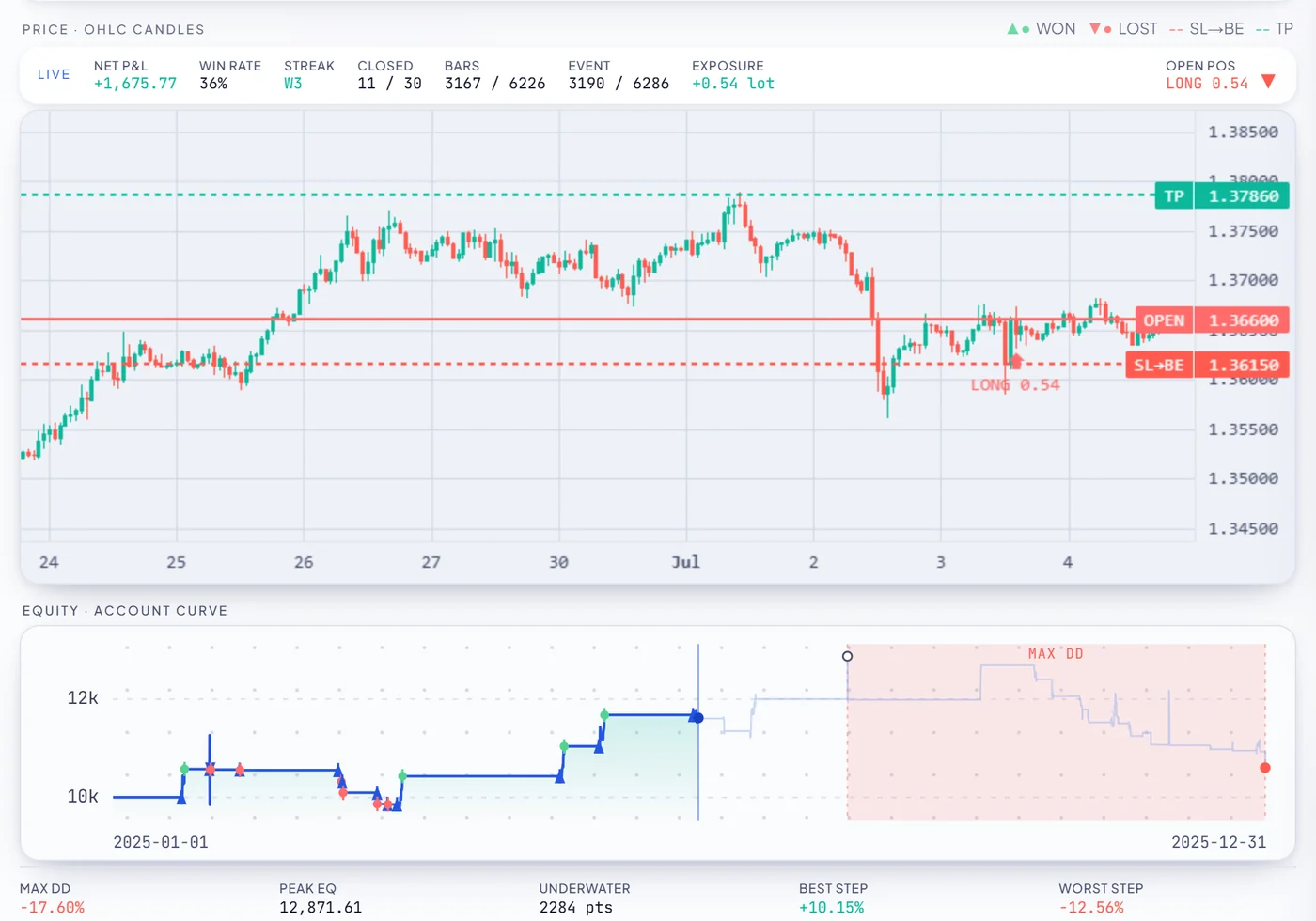
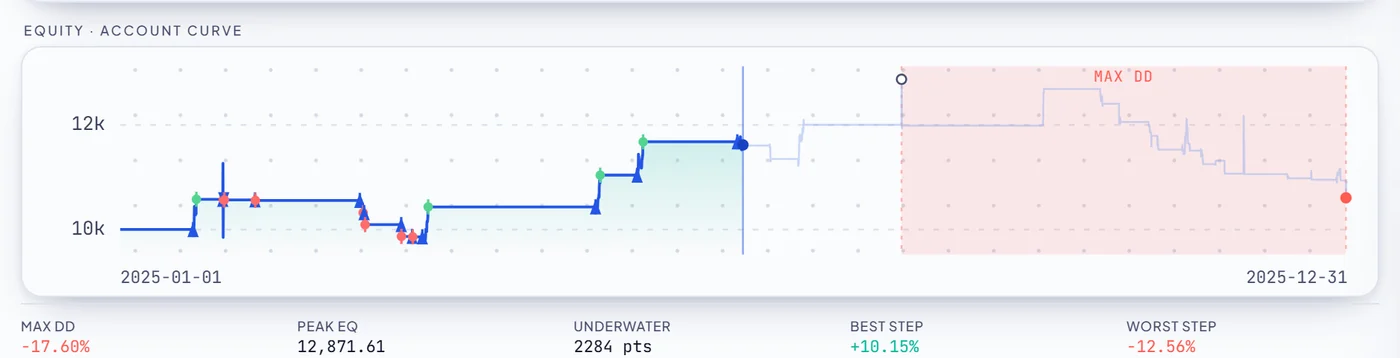
Numbers do not show you how a strategy behaves. Trade replay plays the actual backtest back bar by bar on real candles, as in the image at the top of this page: entries and exits marked, the account curve building underneath, the worst drawdown shaded. It costs nothing because the run already exists.
Every year, separately
Validation re-runs a strategy on each year of data as an independent backtest, at one token per year. Automatic validation is on by default: any strategy in a batch that returns 25% or more on its backtest gets its per-year grid without a click. This is the per-year table from the checklist, and it is how you keep years aside: choose on some, judge on the rest.
Backtest a strategy free, on real spread
250 tokens on signing up, no card. Real data, real recorded spread, every year validated separately, trade replay and MT5 export included.
The limits
What free backtesting does not include
A free tier that lists only what you get hides the part you find out about after signing up. Here are the limits:
250
tokens, once, no refresh
4 of 34
strategy directions
100
saved strategies
1 yr
window per single backtest
- The grant is one-time. A free account has no billing cycle, so the 250 tokens do not refresh. When they are spent, more work needs a plan.
- One calendar year per single backtest. You pick the year from a list, and custom date ranges are on paid plans. Daily-timeframe batches open on the full range automatically, and validation covers every year, so multi-year evidence is still there. It just arrives as one result per year.
- No editing. You can run what the generator invented, read its schematic and every metric, and export it. Changing its indicators, symbol, year, cost model or risk is paid. That includes re-running it with costs off to see the difference yourself.
- 30 strategy directions locked. Free Compose uses 4 of the 34 archetypes. The rest, along with AI tuning, the variation refiner and running the preset library, are paid.
If you outgrow it, the entry plan is starter at $49 / mo, with 20,000 tokens that refresh monthly. Full pricing is here. And whichever tool you settle on, the studies above apply to it. A backtest without its costs, its separate years and its drawdown shows you very little, whatever it cost to run.
FAQ
Free backtesting questions, answered
What is the best free backtesting software for forex?
It depends on whether you already have a strategy in code. If you trade on MetaTrader 5, its built-in Strategy Tester comes with the terminal and can test on real ticks accumulated by your broker, but you need an expert advisor to run in it. RoboticEA's free tier generates strategies without coding, backtests them on real market data with real recorded spread, commission and swap, and re-runs each one on every year separately before you export it to MetaTrader 5. Whichever you choose, check the data, the costs, the per-year results and the drawdown before you trust any number it gives you.
Is the MetaTrader 5 Strategy Tester free?
Yes, it is part of the MetaTrader 5 terminal. MetaQuotes' documentation describes an 'Every tick based on real ticks' mode that tests on real ticks accumulated by brokers with no simulation, plus a visual mode, multi-currency testing and optimisation. It is a strong free backtester. What it needs from you is an expert advisor to test, and per-year or holdout testing is left to you to set up run by run.
What does RoboticEA's free tier include for backtesting?
A one-time grant of 250 tokens with no card. One new backtest costs 1 token, and a per-year validation across the 9 years of data (2018 to the current partial year) costs 9. Every run uses real market data and charges real recorded spread, commission and overnight swap inside the simulation. Trade replay of a run you already have and MetaTrader 5 export cost nothing, and free accounts can keep up to 100 saved strategies.
What does free backtesting on RoboticEA not include?
The 250 tokens are one-time and do not refresh. A single backtest covers one calendar year picked from a list, because custom date ranges are on paid plans, though validation still runs every year separately. You cannot edit a generated strategy's logic, symbol, year, cost model or risk on free, Compose uses 4 of the 34 strategy archetypes, and AI tuning, the variation refiner and running the preset library are paid.
How much does the spread change a backtest?
More than any other setting we have measured. On gold, 65 strategies had a perfect 8-year record with costs switched off and none did with the real recorded spread charged, on the identical runs. Charging a flat one-pip spread instead of the recorded one turned 2,784 yearly backtests (8.4%) from a loss into a profit, and removing costs entirely flipped 24.0%.
How many years should a forex backtest cover?
As many as you have data for, shown one year at a time, with some years kept aside. In our gold study only 6.5% of strategies made money in 2018 against 30.6% in 2025, with nothing changed but the year. And picking the best on past years is partly luck: the top 100 GBPUSD strategies by 2018-2023 return compounded a median +333% there and then a median -50.9% over 2024-2025.
How accurate is RoboticEA's backtest compared with MetaTrader 5?
Close, when both are fed the same prices. Running 100 strategies through our engine and MetaTrader 5's tester on the same real EURUSD ticks cut the median gap in total return from 8.97 to 6.07 percentage points compared with a stream built from bars, and 90 of the 98 scored strategies landed within 10% of each other on trade count. Your broker's data and costs differ from ours, so run any exported strategy in MetaTrader 5's tester before trading it.
The study figures come from three saved artifacts: the gold study (186,637 engine runs, build 0.2.0), the 100-strategy MetaTrader 5 parity board, and the GBPUSD transplant holdout. Every product figure comes from the constants the server enforces.
Keep reading
MT5 Strategy Tester accuracy: real ticks vs synthetic
The price-path study in full: two simulators, two tick models, and where they still disagree.
What 9 years of gold backtests show
The cost-model study: real recorded spread against a flat pip and against nothing.
A free expert advisor for MetaTrader 5
From a backtest to a readable .mq5 file, and what is inside it.
Does our engine agree with MetaTrader 5?
Run for run against MetaTrader 5's own Strategy Tester.